Shiva and Shakti: The Sublime Poetry of Jnaneshwar
Who is Shiva? Can he exist without Shakti? But who is Shakti if not Shiva?
Philosophers over the ages have tried to capture the transcendence of the Absolute through words, but few succeed. Language is inherently dualistic. There is the word, and there is its object, however, the absolute is non-dual, beyond description. The most famous effort to capture this non-dual Absolute through language was via negativa – neti, neti (not this, not this). In this definition, any reality that can be captured by language is, by definition, not God.
This negative definition of the Absolute by the Vedāntins would be very unsatisfactory to the followers of tantric Hinduism. For them reality is not an illusion but the very manifestation of the Absolute. The supreme consciousness congeals itself into the materiality of the manifest universe. The unmanifest consciousness, Śiva, manifests itself in this world through his inherent Śakti, the feminine principle inseparable from Śiva (or in academic-speak, they are ontologically the same but manifest differently).
The non-dual consciousness, though devoid of all materiality, is the source of all materiality. The yogi realizes this unity of reality in the deepest recess of his consciousness. Verbalizing this ontology through poetry is exceedingly difficult. This is a far cry from the dualistic Bhakti poetry where God has a form and participates in the worldly līlā, and therefore it becomes easier to describe the deeds and glory of the Lord through poetry. Among the tantric practitioners, Jñānadeva, Lāl Ded and Utpaladeva, are some of the few saints who have composed devotional poetry. In what follows, I will highlight Jñānadeva attempt to capture this non-dual reality via poetry.
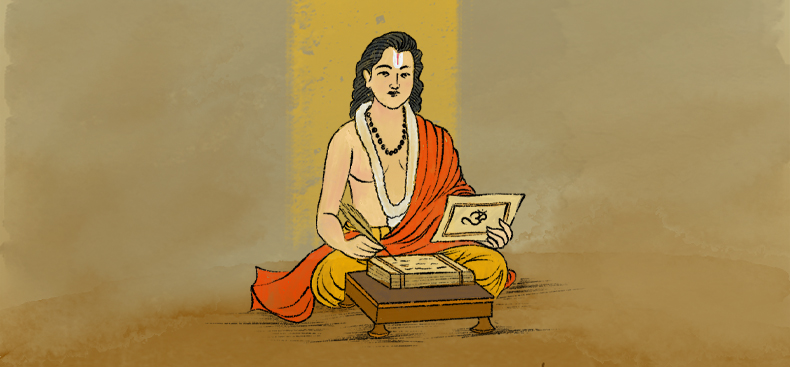
The great 13th-century saint of Maharashtra, well known for his commentary on the Bhagavad Gītā, Jñānadeva was an initiated Nātha Yogi, a practitioner of Śaiva tantra. In Nātha world-view, the reality is one; bhakti and its object is one; the name of God is God itself! When a devotee worships God in devotion, it is God worshipping God! The world appears dual due to the Śakti of Śiva, but in reality, everything is Śiva. Jñānadeva, in his brilliantly evocative Marathi poetry, Amṛtānubhava manages to capture this non-dual nature of reality, the mysterious interplay of Śiva and Śakti, that is unmatched in the history of Hindu literature. If you are lucky enough to read the first few chapters of Amṛtānubhava, please read it in the original Marathi. For our purposes, we will quote the verses from the first chapter of Amṛtānubhava, translated by S.Abhayananda.
The lover (Śiva) out of boundless love Has become the beloved (Śakti)
Out of love for each other, they merge; And again, they separate for the pleasure of being two
Though they perceive the universe Of inanimate and animate creation Emanating from themselves They do not recognize a third
They sit together on the same ground Wearing the same garment of light From time past remembrance they have lived thus, United in Bliss
Difference itself merged in their sweet union When, seeing their intimacy It could find no duality
Because of God, the Goddess exist And without her, he is not. They exist only because of each other
How sweet is their union! The whole world is too small to contain them Yet they live happily in the smallest particle
Jñānadeva here is trying to describe the paradoxical nature of reality. The consciousness manifests itself out of sheer fullness of its being, but this manifestation is impossible without an active principle which is called Śakti. But Śakti is the very being of Śiva. When they separate, the world of diversity manifests itself, but this separation is not possible because if everything is one, there is nothing to separate from. Jñānadeva writes,
They become two for the purpose of diversity And both are seeking each other For the purpose of becoming one Each is an object to the other, And both are subjects to each other Only when together do they enjoy happiness
It is Śiva alone who lives in one forms He is both the male and the female. It is because of the union of these two complements That the whole universe exists
Two lutes: one note Two flowers: One fragrance Two lamps: One light
Two lips: One word Two eyes: One sight These two: One universe
The entire universe is a play or manifestation of Śiva and Śakti, who are both one but manifest differently. Without Śiva, Śakti cannot exist, while Śiva cannot manifest itself without Śakti. They are twins but united in a primal bond. Jñānadeva says they are like sugar and sweetness or sun and its rays; both different and yet have the same source. In the same vein, Jñānadeva writes
Through her, The absolute void becomes the manifest world
But her existence Is derived from the Lord Śiva himself becomes his beloved But without her presence no universe exists
Because of Her form, God is seen as the world But he created Her form Of Himself
Embarresed by her formless Husband And her own graceful form She adorned him with a universe Of myriad names and form
Although he is manifest He himself cannot be seen It is only because of her That he appears as the universal form
While he sleeps, she gives birth To the animate and inanimate worlds When she rests Her husband disappears
Here Jñānadeva is describing the interplay of Śiva and Śakti. When one does not recognize Śiva, one can only see his manifestations, Śakti, but when one sees Śiva (or gain enlightenment), the Śakti disappears into the unmanifest void of Śiva. Jñānadeva says that the seeming duality of Śiva and Śakti will vanish once the devotee can set their ego aside. In the deepest state of mediation, as the ego dissolves into nothingness, at that very moment, Śiva embraces Śakti in an eternal embrace, both merging into the primal unity of the uncreated existence.
Note: I have just captured the beginning few pages of Amṛtānubhava. Meditation on this profound poetry of Jñānadeva itself is a means to transcendence. As mentioned, I have followed the translation of S.Abhayananda, which I find more poetic than other translations. Readers wanting to read Amṛtānubhava in English can also use the translation of OP Bhairut, widely used in academia for Jñānadeva studies.