A Vision for the Hindu Temples
An 800-year-old Karnataka inscription as a blueprint for what a temple can be — far more than a place for darshan.
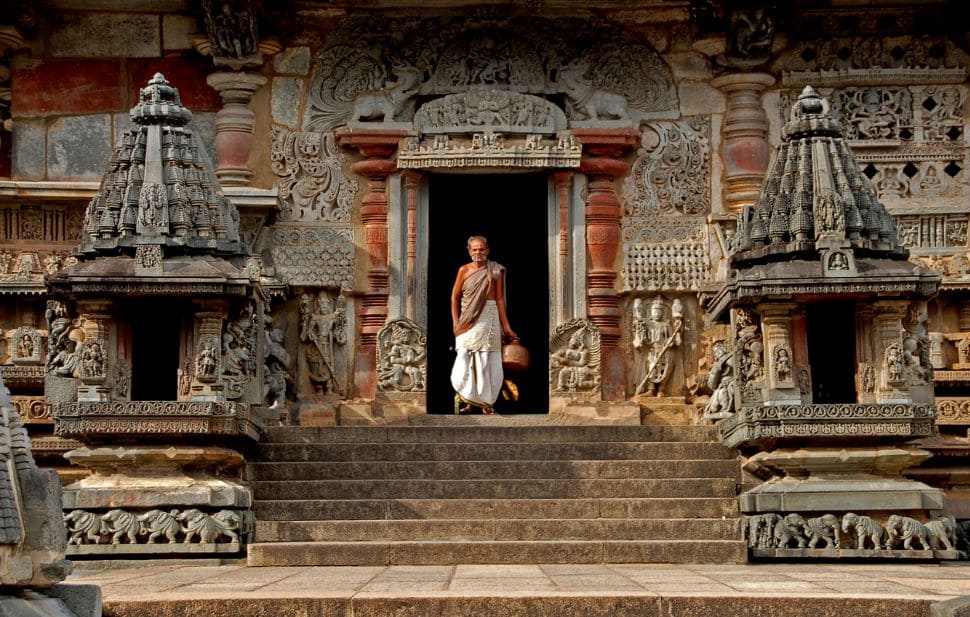
Karnataka has an astonishing number of archaeological and inscriptional records which provide us with a glimpse of the flourishing temple traditions of the early medieval period under the patronage of devout kings and merchant guilds. Particularly interesting is an 800-year-old inscription found at the Kedāreśvara temple of Belagavi, Karnataka, dated to 1162 CE, which delineates the role and the activity of the temple and its associated maṭhas [translated by Florinda De Simini]:
“…the established place (niṣṭhitasthāna) for the ritual practice of the Śaiva ascetics who are perpetual chaste students; a place for the self-recitation (svādhyāyasthāna) of the four Vedas—the Ṛg, Yajus, Sāma, and Ātharva—along with their ancillary treatises; a place for teaching (byākhyānasthāna) grammar, such as the systems of Kumāra, Pāṇini, Śākaṭāyana, and the Śabdānuśāsana; a place for teaching the six systems of philosophy—namely the Nyāya, Vaiśeṣika, Mīmāṃsā, Sāṃkhya, Buddhist, etc.; a place for teaching the treatises on Yoga—namely the Lākulasiddhānta, the work of Patañjali, and others; a place for various [branches of] learning (vividhavidyāsthāna), such as the 18 Purāṇas, the Dharmaśāstras, all Kāvya compositions, drama, dance, and so on; a place for the provision of food (annadānasthāna) to the poor, the helpless, the crippled, the blind, the deaf, story-tellers, singers, musicians, flute-players, dancers, Vaitāḻikas, the naked, the injured, and the mendicants coming from various regions, like Jain mendicants, those bearing a single or triple staff, and the haṃsa and paramahaṃsa mendicants; a place for the medical treatment (bhaiṣajyasthāna) of the diseases of the many helpless and sick; and a place for offering protection (abhāyapradānasthāna) to all living beings.”
Let us recap the content of this inscription. A temple is a place for ritual practice for the celibate Śaiva ascetics; it is a place for the recitation of the Vedas and the ancillary branches of Vedic learning; it is a place for learning the six systems of Indian philosophy; it is a place for learning yoga, the Purāṇas, the Dharmaśāstras, Kāvya, drama, dance, and so on; it is a place for providing food and relief to ascetics of different orders, the needy, the poor, the crippled, artists, and others; and it is a place for providing free treatment to the helpless and sick. In short, a temple is a place of protection and solace for all living creatures.
This is an astonishingly expansive vision of what a Hindu temple is and ought to be. A temple is not only a place for the darshan of the Lord, but also a place for Vedic recitation, the performance of traditional ritual practices, a learning centre for all Hindu philosophy and art forms, a place for the medical treatment of the poor, and a place of solace and comfort for suffering humanity. Even more radically, a temple is a place of solace and protection for all living creatures.
Currently, there are some temples which run religious schools and medical centres, but, more or less, the temples have been reduced to merely a place for the devotee to have a quick darshan of the Lord. This dramatic reduction of the role and place of the temple in Indian society is a very recent phenomenon. During the 19th century, our large temples were systematically stripped of their role as places for culture and community activity and were reduced to mere places of worship. As the scope of temple activities was drastically curtailed, the dance, music, and art forms patronised by the temples were now left to fend for themselves. As a result, the sacred art forms that had been nurtured in the temples for millennia were increasingly becoming secularized, as the artists had to look for new sources of patronage.
Hindu temples have historically been a seat of learning and culture, and they must regain their role as the source of cultural sustenance and the renewal of Hindu ascetic traditions, sacred arts, and philosophy. This 800-year-old inscription thus becomes a literary symbol and a vision of our aspiration for the modern Hindu temple.